
Which job should you choose when you have two “good” job offers? Start a business or remain an employee? You are at a crossroads and have an important decision to make. However, you do not know which option to choose. YOU STILL HAVE TO MAKE A CHOICE! How should you proceed when facing a professional dilemma in order to make the right choice?
What attitudes should you adopt in such a situation? This article shows you a practical way forward. In addition, we will tell you stories inspired by real events that serve as life lessons.
1. The right attitude to adopt when facing a professional dilemma
Every adult makes 35,000 decisions each day. Some decisions do not affect your life while others can completely change its direction. It depends on their importance and how irreversible they are. Choosing a spouse, a job, or a house are very important and often irreversible decisions. We will focus on decisions with major consequences. Know that you will face dilemmas when making this type of decision.
A dilemma is a situation in which a difficult choice must be made between two different courses of action. During your professional career, you will often face dilemmas.
How should you proceed to avoid the worst outcome and prevent choosing the wrong option? What attitudes should you adopt when facing difficult choices?
a. Do not make decisions under pressure
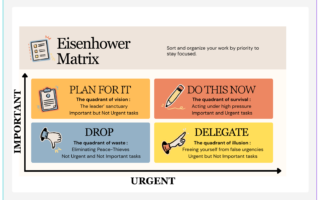
When facing important choices in your life, you must take time to analyze. Avoid making decisions impulsively. Also refuse to act under pressure from time or from others.
Time pressure
When facing a professional dilemma, making decisions under time pressure can have serious consequences.
For example, you may feel that your years of service are accumulating and that you are approaching the deadline you had set for reaching a management position. Seeing time slip away, you put immense pressure on yourself to move up to the next level. You then hastily accept the first available job or promotion offer, without truly assessing the company culture, the real expectations of the position, or its alignment with your values. If you reason this way, this choice made under time pressure may harm you because it is not objective and rests on weak grounds. You should not guide your career solely on the belief that time is running out.
Pressure from others
A well-known technique used by scammers is to put pressure on the people they want to influence until they lose their critical thinking and make the desired decision. They force their victims to choose quickly for fear of missing a “golden opportunity”. We recommend that you refuse to place yourself under this kind of pressure.
As a habit, I avoid making decisions in uncertainty. I prefer to form my own opinion after an in-depth analysis. I make no decision until things are clear to me. It is wiser to do nothing than to make the wrong decision and regret it for life. Do not delegate the final decision to others. You can ask for advice, but do not base your opinion entirely on what others think. When facing a professional dilemma, ask yourself the following questions: What do I think about it? What is my personal choice? The final word is yours, it is YOUR DECISION, it is YOUR CHOICE. Be responsible for your choices and, above all, be prepared to accept their consequences.
b. Analyze objectively (the advantages and disadvantages)

You must clearly define your objective, understand your constraints, and then evaluate the options. Unlike intuitive decision-making which consists of relying on instinct, this objective analysis of the pros and cons of each option follows the method below :
- Define your criteria : Determine the appropriate criteria;
- Rank these criteria according to your values: This involves assigning a weighting coefficient to each criterion according to its degree of importance. This allows you to rank your criteria by priority. The criteria with the highest coefficients are the most important to you;
- Identify the risks associated with each option : This will highlight the disadvantages of each option, enabling you to choose with full knowledge of the facts ;
- Fill in your decision matrix : You assign a score to each criterion for each available option. After weighting the scores (the scores are multiplied by the coefficient linked to the criterion), you calculate the overall average for each option ;
- Select the best option : Your rational choice will select the best option following this evaluation.
c. Seek information from people who have experienced this professional dilemma
The basis of the benchmarking method is very inspiring when you want to compare yourself with the best and, above all, learn from their experiences. This humble attitude saves you time and helps you avoid repeating the same mistakes. In this part, we could include participatory or consensus-based decision-making because you involve other people in the decision-making process.
We advise you to have forerunners, coaches, or mentors who share your values. These role models can share their experiences with you which will serve as lessons.
d. « What does GOD say about this matter? »

As human beings, you are limited. You do not control every aspect and must decide based on the information you know. Therefore, with your limited knowledge, insufficient or unreliable data, and subjective analysis of the facts, you can only make a choice that is often biased. That is why you must turn to the One who knows everything: THE OMNISCIENT.
Life is not only rational, it is also spiritual. There are irrational parameters that come into play. We advise you to rely on God. What does HE say ? You must consult Him through meditation and prayer. Be sensitive to His voice and know His ways. He can answer you in different ways : through someone around you, through a video, audio, image, or text message, through a vision or a dream, through a strong conviction. The following story shows a good example of decision-making by authority because it recognizes the Lord as our supreme authority. We must submit entirely to His will. A professional dilemma is a good exercise for deepening trust in God.
A professional dilemma anecdote
It is sometimes difficult to discern and accept God’s will when it asks us to step out of our professional certainties.
While I was still in the private sector, everything was going very well in my company. I was in a comfortable comfort zone, surrounded by my family and rooted in my country. That was when I received an offer to join an international organization. At first glance and based on the information received, this proposal did not seem particularly attractive. The benefits and compensation were practically identical to those of my position at the time. Moreover, the sacrifices required were enormous : leaving my stability, my country, and my loved ones, to embrace a life of expatriation and uncertainty.
Yet, in prayer, God clearly showed me that this opportunity was His choice for me. Despite my concerns, I chose to place my trust in Him and accept His will.
Once settled there, God’s faithfulness was revealed. I discovered a multitude of unexpected benefits that I had been completely unaware of when I accepted the offer. This transition literally propelled my career to new heights and gave me access to major professional and personal advantages. My family also benefited deeply. My children had the opportunity to grow up in a multicultural environment and become bilingual. Accepting God’s will, even when the path seems demanding at first, remains the best decision to ensure true fulfillment.
The fear of Yahweh is a fountain of life, turning people from the snares of death. – Proverbs 14:27
2. True stories of experiences with professional dilemmas
In this section, we recount stories based on real events. The people involved, under fictional names, take us into their lives, recount their troubling situations and how they reacted to the dilemmas. These situations are unique and cannot be generalized or systematically applied to all similar experiences. It is up to you to follow the previous advice namely to adopt the right attitude in your situation.
a. Professional dilemma 1: Stay in your comfort zone or join a difficult new boss
Tom is an efficient young finance professional, highly appreciated by his supervisor. For his career development, he is offered two positions :
- A promotion in his current department (Option 1)
- or a promotion in another department (option 2).
The two promotions are equivalent in terms of compensation and benefits.
| Advantages | Disadvantages | |
| Option 1 : Promotion in his current department | *Comfort zone *Appreciated supervisor | *No new challenges |
| Option 2 : Promotion in another department | *New challenges *Increase his emotional intelligence with his new boss | *Difficult supervisor |
After careful reflection, Tom chooses to join the new team (Option 2). Despite the challenges, he was ready to take them on. He does not regret his choice because he was able to build a strong relationship with his new supervisor who is now his professional mentor.
💡 Read this article: Quitting your job and becoming a full-time entrepreneur?
b. Professional dilemma 2: Stay in your “golden prison” or resign

Chantal holds a managerial position in a company with an expatriate contract. Her husband and children remained in her country of origin. For ten years, she commutes between her new country and her home country. At the end of this period, she begins to feel the weight of the distance and faces a dilemma:
- Stay in her position (Option 1)
- or resign to rejoin her family (Option 2).
She discusses with her husband in order to adopt consensus-based decision-making. She hopes they will agree on the final decision.
Finally, they decide to prepare for her return (Option 2) through a smooth transition over one year. She adopts risk mitigation measures for each potential problem. Good preparation and anticipation were the key to success of this change.
| Potential problems | Mitigation measures | |
| Option 2 : Resign | 1* Being unemployed 2* Finding a new, lower-paid position | 1* Active search for a new job during the 12 months before her return 2* Compensate with good current savings and a side activity |
Today, she has found an equally rewarding new position in her country of origin, lives with her family, where everyone is fulfilled and happy to live together.
💡 Also read the article on: Expat life – How to truly succeed when moving abroad?
c. Professional dilemma 3 : Take responsibility and risk losing your job (Option 1) or expose your colleague to keep your position (Option 2)
Victor, a company executive finds himself managing a mistake made by his colleague with serious consequences for monthly sales results. As a manager, he must decide how to report to the managing director :
- Take responsibility and risk losing your job (Option 1)
- or expose your colleague to keep your position (Option 2).
He entrusts this critical situation to his God through prayer in order to find the right words. The next day, he reports to the managing director by assuming full responsibility for this professional mistake (Option 1) rather than pointing the finger at his colleague, because it is an error from his department.
As a team leader, he believes that successes belong to the group, as do mistakes. According to his conviction, the team leader is everyone’s protector. To his great surprise, this did not cost him his position. The managing director simply gave him a warning, and his team appreciates him even more. The sense of belonging to a team increased in his group with better communication and better performance.
In conclusion, always calmly analyze any professional dilemma you face and adopt the right attitude.
Do not hesitate to share this article and, above all, leave me your comments on this article. What dilemma are you experiencing, or how did you get through it ?