
Introduction: Discovering this leadership tool
As this proverb so aptly puts it: “Not rest on your laurels“, every leader aspiring to a lasting impact should draw inspiration from this. Too many managers lock themselves in the nostalgia of past exploits: “I achieved this at my previous company” or “We have always done it this way.” Yet, your collaborators, superiors, and clients are waiting to see the value you create today. The Deming Cycle, or the PDCA method (Plan-Do-Check-Act), is the flagship tool for this mindset. It is a dynamic cycle that transforms every error into a lesson and every success into a new standard. It is a professional life philosophy that refuses stagnation. By adopting this wheel of continuous improvement, you move from static leadership to evolutionary leadership, capable of adapting to environmental changes with agility and precision. This is the secret of organizations that span decades without losing their relevance.
To integrate this culture of excellence into your daily life, it is essential to understand that PDCA is not a simple checklist, but a rigorous system born from industrial requirements to serve human and operational fulfillment.
1. Genesis and foundations : The roots of the Deming cycle
I discovered this method at the very beginning of my career, while I was interested in total quality standards. Originally, this approach was popularized by William Edwards Deming in the 1950s to radically transform post-war Japanese industry. Although its roots are deep in statistics and the manufacturing environment, I quickly realized that its power was universal. I successfully applied it in logistics, procurement, and even during the redesign of international strategic visions. The Deming Cycle goes far beyond the boundaries of the Quality department; it is an indispensable global management tool for any leader wishing to anchor their organization for the long term.
a. Historical heritage: From Shewhart to Deming
It is fascinating to note that this method often carries two names, reflecting the richness of its heritage. The initial concept is based on the work of Walter A. Shewhart, an American physicist and statistician who, in the 1930s, theorized the “Plan-Do-See” cycle. It was his student and friend, William Edwards Deming, who took up the torch and refined the model into the famous PDCA we know today. Deming insisted that the cycle never stops. To pay tribute to Deming’s massive impact on the Japanese economic miracle, the management world named this tool the “Deming Wheel.” Understanding this link between the master (Shewhart) and the disciple (Deming) reminds us that great leadership is above all a matter of transmission and improvement of the received heritage.
b. Definition: More than an acronym, a virtuous loop

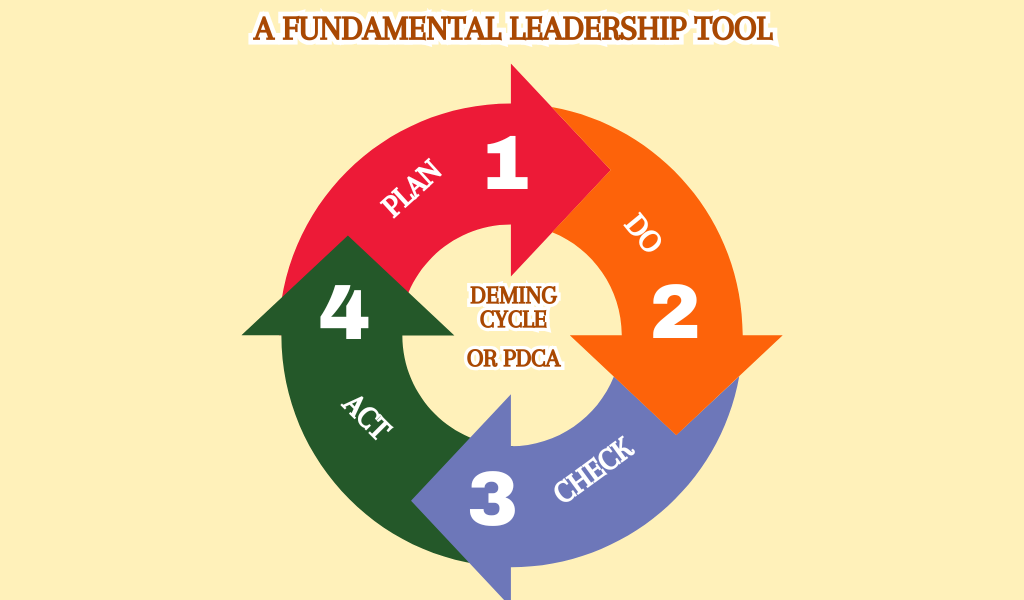
PDCA is a cyclic quality management model aimed at the uninterrupted improvement of processes, services, and products. The acronym details a rigorous procedure to follow:
- “P” for Plan: Identify the problem and define objectives.
- “D” for Do (or Develop/Deploy): Deploy and test the solution, often on a small scale.
- “C” for Check: Measure results and compare them with forecasts.
- “A” for Act (or Adjust/Improve): Take corrective measures or standardize the solution.
This definition implies permanent questioning: once an improvement is stabilized, the cycle must imperatively restart to identify the next opportunity. It is a discipline of the mind that refuses the “status quo” and favors constant small steps over risky giant leaps.
In summary:
- PDCA (Plan-Do-Check-Act): The acronym describing the four stages of the cycle. This is the technical and operational name of the method.
- Deming Wheel (or Cycle): The “tribute” name given to this tool in honor of William Edwards Deming, the American statistician who popularized this approach.
c. The principles of the Deming cycle: Pillars of stability and progress
PDCA is based on fundamental principles that guarantee its effectiveness. The first is the factual approach: the leader does not decide based on impressions or pressure, but on measurable data collected in the field. The second principle is the leader’s humility. Admitting that a process can be improved is accepting that perfection has not yet been reached. Finally, it is a participative method: it requires the direct involvement of those who perform the work, as they hold the keys to real efficiency. The leader here becomes a facilitator who provides a secure framework for their teams’ innovation.
d. The symbolism of the wheel: Movement and the wedge of success
Why talk about a “Wheel”? This image symbolizes perpetual movement towards excellence. This wheel is often represented climbing an inclined plane, illustrating the effort required to raise the level of performance. The crucial principle here is the fight against regression: to prevent the wheel from coming back down under the weight of routine, a “wedge” is placed under it. This wedge represents standardization. Without written and respected standards, improvement is only a fleeting stroke of luck. The wheel reminds us that leadership is a constant effort: if we stop turning it, the organization naturally ends up stagnating or regressing.
Why do so many leaders across the world swear by this method? The answer lies in the tangible and measurable benefits it brings to global performance.
We recommend reading this article which shows ➽ how LeaderDirection was inspired by the Deming Wheel or PDCA to develop its P.A.I.X method, a powerful tool for professional fulfillment.
2. The advantages : Why the PDCA cycle is a leader’s best ally?
The impact of the PDCA cycle on overall performance is well-established. Industrial and logistics statistics show that organizations adopting a continuous improvement approach see their productivity increase up to 25%, while reducing their non-quality costs. But beyond the numbers, it is organizational health that benefits. A company that turns its “wheel” is a company that learns and refuses stagnation. By eliminating waste and refining processes, precious time is freed up for innovation and employee fulfillment, thus reducing stress related to repetitive emergencies. It is a true shield against professional exhaustion.
a. Drastic reduction of hidden costs and non-quality
Every repeated error, every double entry, or every delivery delay is a “waste” cost that hampers profitability and drains the nerves of the teams. The major advantage of PDCA is the systematic identification of these flaws. Instead of simply “repairing” the problem on the surface (symptomatic treatment), we go back to the root cause during the planning phase. By investing time to understand the why of the failure, we save colossal sums by avoiding rework, penalties, and customer complaints. In the long term, the company gains a reputation for unshakable reliability, which constitutes the most precious competitive asset in a saturated market where customer trust is the ultimate currency of success.
b. Team engagement and skill development
PDCA transforms employees from mere executors into true actors of change. By involving them directly in the Check and Act phases, the leader empowers them and gives meaning to their daily work. This advantage is above all psychological: an employee who actively participates in the improvement of their own workstation is an engaged employee, proud of their contribution and more resilient. Talent retention is naturally strengthened, as the work environment becomes a place of continuous learning and recognition of skills, rather than a monotonous and frustrating routine. Leadership then becomes a facilitator of collective solutions rather than an isolated order-giver.
c. Strategic agility and resilience to change

In an increasingly volatile professional world (the VUCA world – Volatility, Uncertainty, Complexity, Ambiguity), the ability to pivot quickly is a matter of survival. PDCA offers the leader unparalleled agility. By working in short cycles, you do not commit to pharaonic projects without certainty. You test, you learn, and you adjust. This advantage allows the organization to remain flexible and adapt to new market demands or unforeseen crises without losing its direction. The Deming cycle acts like a radar: it allows you to detect weak signals of inefficiency and correct them before they become catastrophes. It is this controlled reactivity that separates fulfilled leaders from managers overwhelmed by events.
d. Sustaining excellence through standardization thanks to the Deming cycle
One of the greatest tragedies in business is “memory loss”: a problem is solved, then six months later, it reappears because good practices evaporated with the departure of a colleague. PDCA solves this problem thanks to the “Act” stage which imposes standardization. The famous “wedge” placed under the wheel prevents any backward movement. This advantage guarantees that each improvement becomes the new foundation of the company. For the leader, it is the assurance of total peace of mind: you no longer have to explain the basics over and over again. Performance becomes systemic and no longer dependent on the mood or presence of a particular person. You thus build an unassailable legacy of quality.
e. Decision objectivity and reduction of internal conflicts
Finally, PDCA improves relationships within teams by replacing subjective opinions with measurable facts. Too many conflicts arise from divergent perceptions: “I think it’s logistics’ fault,” “I believe marketing isn’t doing its job.” With PDCA, we rely on the control phase (Check) to obtain indisputable data. This advantage allows the leader to settle debates in a fair and transparent manner. Tensions drop because we no longer look for a culprit, but for a flaw in the process. This culture of data and factual truth strengthens team cohesion and allows all creative energy to be focused on problem-solving rather than power games or sterile criticism.
To reap these fruits and radically transform your professional daily life, it is now imperative to strictly follow the precise choreography of the four stages of the cycle.
3. The stages of the Deming cycle: The mechanics of success
Deploying the Deming cycle requires methodological rigor. It is not about rushing into action, but about respecting a balance between reflection and execution. Too many managers fail because they spend 90% of their time in the “Do” phase and neglect the rest.
a. Plan: Define the target and strategy
This is the most crucial stage and, paradoxically, the most often botched. Planning consists of clearly identifying the problem to be solved or the objective to be achieved. Data must be collected, root causes analyzed (via tools like the “5 Whys“), and a precise action plan defined with key performance indicators (KPIs). Good planning also anticipates necessary resources and potential obstacles. If you spend enough time here, the rest of the cycle will proceed with surprising fluidity.
b. Do: Deploy and test in the field (2nd stage of the Deming cycle)
Once the plan is established, it is time to move to action. However, “Do” in PDCA does not necessarily mean an immediate massive deployment. It is often recommended to test the solution on a small sample or a pilot project. This limits risks. During this phase, it is vital to document precisely what is being done. We are not just executing; we are experimenting. This stage requires iron discipline to respect the procedures planned during the planning phase.
c. Check: Measure results with honesty

This is the moment of truth. We compare the results obtained during the “Do” phase with the objectives set in the “Plan.” Are the indicators green? If the results are not up to par, do not be discouraged but seek to understand the gap. This is where we validate if the starting hypothesis was correct. Without this rigorous control stage, PDCA is just a series of actions without direction.
d. Act: Standardize and prepare the next turn
If the results are positive, we standardize the new method: it becomes the new rule for all (the famous “wedge” of the wheel). If the results are mixed, we adjust. We draw lessons from the experience to decide on the next steps. In any case, this stage closes the loop and immediately prepares the next planning cycle. This is how we enter a dynamic of infinity and sustainability.
e. Variants of the Deming cycle
There is a variant that translates the “A” as “Adjust” instead of “Act” to avoid confusing it with the “D” (Develop/Do).
PDCA also gave rise to PDSA (“S” for Study) to emphasize the stage of in-depth study rather than simple verification.
There is another variant that adds an “O” at the beginning of the cycle to become OPDCA, with the “O” standing for “Observe.” Thus, observation is a key step before any approach.
Now that we have mastered the mechanics, let’s see in which specific contexts this method can transform your daily life as a leader.
We encourage you to read this article on ➽ the right start to succeed in your professional life.
4. Areas of application : When to spin the Deming cycle in your professional life ?
The PDCA cycle is absolutely flexible. Contrary to popular belief, it is not limited to the production lines of car factories. Whether you lead a bank, a creative agency, or a farm, this method adapts to the complexity of your environment. It becomes your shield against chronic inefficiency and waste of resources. In every sector, the continuous improvement wheel allows for a shift from reactive management, where one simply endures events, to proactive management, where performance is driven with real precision. Let’s explore how these precision mechanics are transforming different pillars of the economy.
a. Logistics and Supply Chain: The art of flawless fluidity

In this world where every second counts, PDCA is vital. It is used to optimize the flow of goods, reduce order preparation times, and improve inventory reliability. For example, if you notice a high error rate in your shipments, you plan a new double-check protocol. You deploy it on a specific preparation line, check the actual decrease in customer disputes, then adjust and standardize the procedure for the entire warehouse. PDCA thus guarantees operational fluidity, which is the pride of every logistics professional and ensures the long-term sustainability of the customer promise.
b. Procurement and Strategy : When the Deming cycle transforms costs into investments
In strategic contract management, PDCA helps evaluate supplier performance over time. Objectives for cost, quality, and corporate social responsibility (CSR) are planned. We observe actual performance, check gaps during Business Reviews, and adjust the sourcing strategy accordingly. The procurement leader no longer just negotiates prices; they turn the wheel to build an ecosystem of reliable partners.
c. Finance and Economy : Securing profitability and compliance
In the financial sector, the Deming Wheel is the preferred tool for risk management and the optimization of budget cycles. When a monthly closing process is too long or riddled with errors, the finance team plans for data flow automation. They test this solution on a subsidiary, verify the accuracy of the reports produced compared to legacy systems, and then adjust internal controls before rolling out the method globally. In management economics, PDCA allows for the tracking of budget variances almost instantaneously. By addressing root causes rather than simply enduring year-end financial statements, the financial leader protects company margins and ensures the strategic visibility essential to investors.
d. Marketing and Customer Experience : Driving impact and conversion
Modern marketing has become a science of continuous experimentation. Whether it involves digital campaigns or product launches, PDCA is at the heart of marketing agility. A campaign is planned based on a hypothesis of customer needs, a test is deployed on a narrow market segment, conversion rates and consumer engagement are verified, and then the message or distribution channel is adjusted to maximize impact before the national launch. This loop prevents massive investments in concepts that fail to find their audience. The marketing leader thus becomes a strategist who refines their tools in real-time to offer a customer experience that is ever more memorable and profitable.
e. Agriculture and Agribusiness: Cultivating sustainable excellence
Even in contact with the soil, the PDCA method revolutionizes productivity and sustainability. In modern agriculture, crop cycles are planned by integrating weather data and input requirements. New irrigation or precision fertilization techniques are applied to a control plot, where yield trends and soil health are verified against traditional methods, and then technical pathways are adjusted for the following season. In agribusiness, this allows for the reduction of resource waste (water, fertilizer) while increasing farm profitability. The agricultural leader uses the Deming Wheel to reconcile economic performance with environmental respect, thereby ensuring a fertile legacy for future generations.
f. Table of 10 key sectors and the application of the Deming wheel
| Sector | Practical application of the PDCA method |
| 1. Logistics | Optimize goods flow by testing automated storage. |
| 2. Procurement | Evaluate suppliers then adjust contracts to create value. |
| 3. Finance | Automate monthly closing to reduce entry errors. |
| 4. Marketing | Test targeted digital campaigns before generalizing the budget. |
| 5. Agriculture | Adjust crop cycles based on collected weather data. |
| 6. Healthcare | Improve care by standardizing patient reception protocols. |
| 7. Education | Adjust pedagogical programs after analyzing student success. |
| 8. IT / Digital | Fix software bugs through iterative testing cycles. |
| 9. HR | Optimize recruitment by refining candidate selection criteria. |
| 10. Construction | Secure sites by daily verification of safety standards. |
Each sector has its own challenges, but the resolution approach remains the same. To transform these concepts into concrete results, let us now examine real-world cases where this method has saved critical situations.
5. Real-life use examples : From the field to the office
a. Case #1 : Resolving a delivery lead time crisis
A distribution company suffered from chronic delays.
- Plan: Flow analysis and identification of a bottleneck at the unloading dock.
- Do: Test a new appointment system for carriers for one week.
- Check: 30% reduction in waiting times.
- Act: Generalization of the appointment software. Result: Peace restored on the dock and satisfied customers.
b. Case #2 : Improving HR data quality through the Deming cycle
An HR department received erroneous reports.
- Plan: Identify sources of entry errors.
- Do: Implementation of forms with dropdown lists.
- Check: Audit after one month. Errors dropped by 80%.
- Act: Locking old files and updating the induction procedure for new employees.
c. Case #3 : Optimizing management meetings
Too many unproductive meetings.
- Plan: Define a new format (15 min standing, agenda sent 24h before).
- Do: Application of the format for two weeks.
- Check: Team survey – perceived time gain of 1h per week per executive.
- Act: Official adoption of the “Stand-up meeting” format.
Conclusion
The PDCA method or the Deming cycle is much more than a technique: it is the DNA of the fulfilled leader who refuses mediocrity. By turning this wheel constantly, you protect your organization against obsolescence and offer your teams a secure and stimulating framework. Leadership is not a fixed position; it is a perpetual movement towards the better. Don’t wait for the next crisis to act. Start planning your next success today, one small step at a time.