“This spare part is urgent, or the factory might close!” This statement had become a daily refrain when I was appointed Director of Purchasing and Logistics at a manufacturing plant. Barely settled in, I found a team overwhelmed, living in a permanent state of tension. To break free from this spiral, I had to learn how to anticipate using the Eisenhower Matrix—a tool that allows you to shift from reaction to anticipation by radically changing your mental software.
Since our university training, we have been conditioned to believe that a good manager is the one who runs the fastest, puts out the most fires, and works constantly under pressure. But is that truly leadership? Enduring hazards while waiting for the next crisis? To free yourself, you must move from reaction to anticipation, which requires a radical shift in mindset. It is no longer just about managing time; it is about managing priorities. We tell you everything about this fulfilled leadership tool: its history and why it is the ultimate rampart against professional burnout.
1. History and Impact: The Eisenhower Matrix, from the military to the corporation
This leadership tool is not just another productivity gadget or a time management trick destined to be forgotten in a drawer. It is a true strategic legacy born in the heart of the 20th century’s greatest global challenges. It rests on a fundamental distinction between immediacy and value. As the man who gave it his name emphasized, what is urgent is rarely important, and what is truly important is never urgent—if one knows how to handle it in time. Learning to master this matrix means learning to stop chasing minutes and start walking confidently toward your goals.
a. Origin and role of the Eisenhower Matrix
The tool is named after Dwight D. Eisenhower, the 34th President of the United States and a five-star general. During World War II, he had to sort through thousands of pieces of information to decide which deserved his immediate attention and which should be delegated. Later, Stephen Covey popularized the Eisenhower Matrix by explaining that time management should not focus on speed, but on direction. In his cult book, The 7 Habits of Highly Effective People, he popularized the use of these quadrants. Later, in his book First Things First, he deepened this approach by explaining that time management should not focus on the “clock” (speed), but on the “compass” (direction). It is this shift from speed to vision that changes everything for a leader.
b. Role or Impact on your life: Much more than an office method
The power of this matrix lies in its universality: it applies to all areas of your life, far beyond the walls of the office or the factory. It is a compass for your overall existence. To illustrate this impact, Stephen Covey often used the striking analogy of the “Jar and the Rocks.”
Imagine your life is an empty jar that you must fill. If you start by pouring in sand and small gravel (futile emails, constant interruptions, minor emergencies), you will quickly find that you will never have room to fit your big rocks. These big rocks represent what truly matters: your relationship with God, your family, your physical and mental health, and your long-term vision. Conversely, if you place the big rocks in the jar first, the sand and gravel will always find a place in the gaps. By learning to identify your real priorities through the matrix, you stop being a breathless executor—a slave to others’ agendas—and become a fulfilled leader who controls their own destiny and protects their inner peace.
2. The duel of forces: Discerning the essential with the Eisenhower Matrix
To succeed as a leader without sacrificing your health, it is imperative to know how to arbitrate between Urgency and Importance. Too often, we confuse motion with progress.
Urgency is a time constraint, an external pressure that demands an instinctive and immediate reaction. It is loud and imposes itself upon us. Importance, on the other hand, is a matter of value, vision, and mission. It concerns everything that truly builds your long-term goals and solidifies your leadership. Understanding the nuance between these two criteria is not just a scheduling issue; it is the founding act of your professional freedom.
a. Urgency: Breaking free from the tyranny of “Right Now”

To illustrate the power of urgency, let me share a personal experience. When I arrived at the factory, we were faced with recurring stockouts of toilet paper. This may seem trivial, even anecdotal, but in a tense industrial context, this logistical detail directly affected the dignity and well-being of the employees. Such a stockout could trigger a general strike in a few hours, paralyzing the entire production line.
The result? My team and I spent 80% of our days managing these micro-crises, leaving only 20% of our energy to think about global strategy. We were firefighters, not leaders. Urgency dictated our behavior. What truly makes a task urgent? Is it a real crisis or simply the result of poor planning? Can we prevent this fire from reigniting tomorrow?
The solution did not lie in our ability to run faster to buy paper, but in our ability to take a step back. Using the Eisenhower Matrix daily allowed us to regain unshakeable serenity by taming immediacy. By establishing rigorous safety stocks and signing framework contracts to automate deliveries, we transformed a potential crisis into an invisible process. Getting our “heads out of the handlebars” allowed us to kill urgency through organization. This is precisely where an effective leader is recognized: the one we admire because, even in the midst of chaos, they seem inhabited by unshakeable serenity because they have tamed immediacy.
b. Importance: Building your legacy on the rock
If urgency deals with the present, importance defines your legacy. A task is judged important when it contributes directly to your life mission, your fundamental values, or the sustainability of your organization. The great trap of leadership is that important tasks, unlike emergencies, never “shout.” They have no alarm sirens. They wait patiently in the silence of your office for you to decide to grant them time.
Planning your team’s training, reflecting on your department’s vision for the next two years, or even taking care of your own spiritual and family balance are crucial activities that are never “pressing” until the day it is too late. If you spend most of your life reacting to what is urgent, you build your career on shifting sand: at the first gust of wind, everything collapses because the foundations are missing.
A leader who systematically ignores the important inevitably loses the meaning of their actions and wears themselves out in a race that leads nowhere. Learning to value importance means making a radical and courageous choice: deciding to devote your energy to what will still matter in ten years, rather than letting yourself be blinded by what shines brightly for only ten minutes. It is moving from a posture of survival to a posture of lasting impact.
We recommend this article : A master blueprint for a good start to succeed at work.
3. Navigating the four quadrants of the Eisenhower Matrix
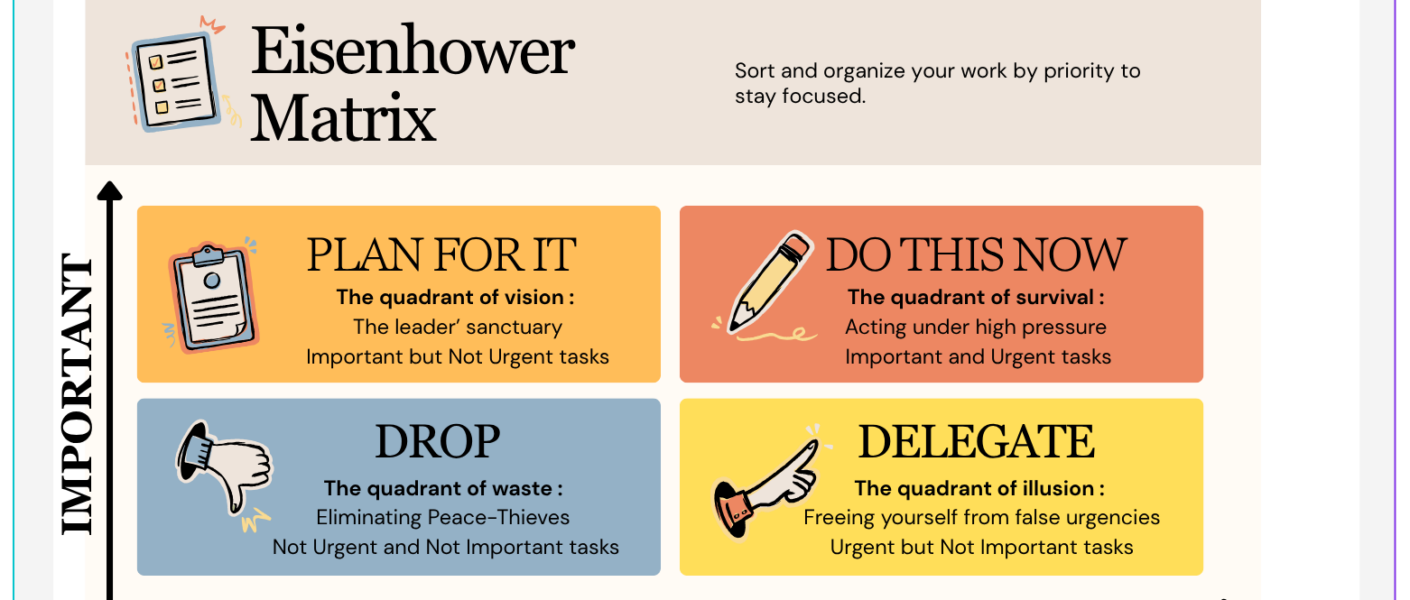
The Eisenhower Matrix does not just classify your tasks; it maps your professional universe into four distinct zones, called quadrants. To visualize how they work, let’s return to the powerful image of the jar we must fill: the Rocks represent your high value-added missions (Important+), the Pebbles symbolize intermediate tasks, and the Sand embodies trivialities and distractions (Futile).
The matrix helps you identify each quadrant and fill them in order. If you let the sand of unimportant emails and constant interruptions fill your jar first thing in the morning, you will find with bitterness that there is no more room for your big rocks. However, if you place your strategic priorities first, the rest will always find a way to slip into the gaps. Ignoring this structure is to condemn your schedule to anarchy.
a. The quadrant of survival: Acting under high pressure (Important+ / Urgent+)

This quadrant is the one of immediate necessity. It is the zone where crises, critical stockouts, and deadlines expiring within the hour collide. Most leaders spend the majority of their careers here, acting like firefighters in a permanent state of alert. Statistically, prolonged immersion in this quadrant inevitably leads to burnout, as cortisol (the stress hormone) levels are constantly at their peak.
In my factory experience, certain strategic contracts with monopoly suppliers fell tragically into this category. Because they had not been anticipated, their renegotiation became a matter of life or death for the company: a last-minute disagreement meant a total machine shutdown, leading to millions in losses.
Practical Advice: Handle these tasks immediately because you have no choice, but do not stop there. Every time a task arises here, conduct an “autopsy”: why did it become urgent? A strategic contract, for example, must be identified and prepared months before its expiration. The goal is to gradually empty this quadrant to leave only true, major unforeseen events.
b. The quadrant of vision: The leader’ sanctuary (Important+ / Not Urgent-)
This is where true, fulfilled, and lasting leadership is forged. This quadrant of the Eisenhower Matrix is dedicated to global strategy, prevention, relationship building, and innovation. It is “the long term.” The absolute trap is that these activities are not “on fire”; they do not shout for your attention. Consequently, they are the first to be sacrificed on the altar of urgency.
Yet, it is by investing here that you reduce tomorrow’s crises. Every time I take on a new role, my first action is to define a clear vision and share it with all stakeholders. This takes time, calm, and introspection, but it aligns everyone and avoids future misunderstandings.
Concrete Example: Mentoring your collaborators. No one will blame you for not coaching your deputy this morning. But in the long term, it is this investment that sustains your impact and allows you to delegate. Schedule these sessions in your calendar as “sacred appointments” with the same rigor as a board meeting.
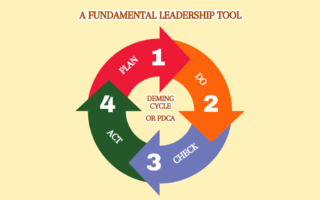
We recommend this article : A powerful leadership tool – Deming cycle or PDCA
c. The quadrant of illusion: Freeing yourself from false urgencies (Not Important- / Urgent+)
The third quadrant is undoubtedly the most treacherous. It gives us the illusion of importance because it demands a rapid reaction. This is the domain of interruptions, certain phone calls, and “urgent” requests from others that do not serve your own goals.
Remember the example of toilet paper or reams of paper in the factory. For a General Manager who cannot print his report two minutes before a meeting, it is an absolute emergency. He may manifest such anger that you end up believing your professional value depends on managing paper stock. This is an illusion. It is a simple process failure that should never mobilize a director’s energy.
Practical Advice: The golden rule here is to delegate or automate. Set up systems, framework contracts, or buffer stocks managed by your teams. Your role is to build the system that fixes the problem, not to fix the problem yourself. Protect your time for what truly requires your expertise.
d. The Quadrant of Waste: Eliminating Peace-Thieves (Not Important- / Not Urgent-)

The final quadrant is for activities with no added value. This is where “time-wasters” hide: infinite scrolling on social media (the famous doomscrolling), meetings without an agenda where people just blow hot air, or corridor gossip that turns into sterile criticism. These are the true thieves of your inner peace.
Be careful not to confuse this quadrant with necessary rest. True rest (reading, meditation, sport) belongs to the Quadrant of Vision (Important). The Quadrant of Waste, however, leaves you more tired after than before. It saturates your brain without nourishing your soul or your career.
Practical Advice: Eliminate these activities without hesitation. Learn the power of the word “NO” to protect your vital energy. If an activity nourishes neither your professional mission nor your personal fulfillment, it simply has no place in your jar. Be ruthless with the sand to let your rocks breathe.
Conclusion
A good leader must know how to organize their work to live in a balanced way. Overload is often a sign of a lack of method, not a lack of time. If you are already overwhelmed as a department head, why would you be entrusted with a directorate covering several departments? By integrating the Eisenhower Matrix into your routine, you stop being a breathless executor and become a fulfilled leader who controls their own destiny and protects their inner peace.
Take this leadership test today: analyze your calendar from the past week. Share in the comments how many “big rocks” you actually place. Improve your management and regain your P.A.I.X.!