Article 4/16 of the P.A.I.X. Method
Let’s be honest: you could be the greatest genius since Einstein, with ideas that would revolutionize even the way we boil water, but if you are alone on a desert island, your ideas will only serve to decorate the sand. I like to say that “even if you have the best ideas in the world, you can do absolutely nothing without others.” This is the core importance of collaborative leadership.
It is here that a piece of wisdom we especially cherish in Côte d’Ivoire comes into play: “C’est l’homme qui fait l’homme” (It is man who makes man). What does this mean? Simply that no one succeeds in a vacuum. Your ascent, your stability, and your fulfillment in your professional life depend on the elevator you send back to others and the strength of the cables you weave with those around you.
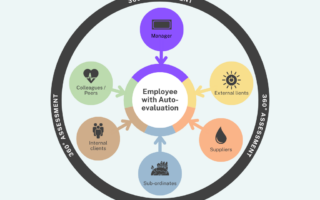
To succeed in this preparation stage, we will explore the 360-Degree Model. Why 360? Because leadership isn’t just about looking down to give orders. It is a panoramic vision that encompasses your superiors, your peers, and your collaborators. Ready for an overview? Fasten your seatbelts, we’re taking off!
1. Collaborative leadership and the law of loyalty

You must navigate with your superior. The first axis of our compass points upward. The relationship with your boss is often the “temperature test” of your professional maturity.
Professional loyalty is the moral and ethical commitment of a collaborator to support their superior’s vision, to protect their legitimate interests, and to preserve organizational cohesion, even in cases of internal disagreement.
a. The choice of the heart: Why loyalty beats expertise
I had a boss who always said: “I look for loyal collaborators rather than the best specialists.” At first, this might be surprising. You think: “But expertise is what makes the company run!”.
Here is the truth: a loyal collaborator, even if technically average at the start, is fertile ground. He/She can be trained, supported, and invested in. He/She is reliable. Conversely, the “brilliant specialist” who is disloyal is a ticking time bomb. They will weigh down the atmosphere, sow doubt, and quickly become “toxic.” Disloyalty is a poison that paralyzes decision-making.
b. The benefits of loyalty
- Total trust: When your boss knows you won’t betray them, they give you access to strategic information.
- Job security: During restructuring, companies keep the loyal pillars upon whom the future can be built.
- A climate of peace: Loyalty reduces office politics and the stress associated with mistrust.
You must remember that your value lies not in what you know, but in your ability to be a reliable ally, a person of trust. Never betray. Do not seek to expose your boss’s weaknesses in hopes of taking their place. Leadership obtained through betrayal is a throne of ice that will melt at the first ray of sunlight. Avoid going in the opposite direction of collaborative leadership; instead, cultivate the strength of the collective: we never rise as high as when we help others stay standing.
c. The art of discretion (or How to avoid the “Tunic syndrome”)
We all have that colleague who broadcasts everywhere that they are the “favorite.” They arrive with coffee, laugh too loud at the boss’s jokes, and want to show they are “friends.” Beginner’s mistake! Remember Joseph in the Bible. His father loved him more than anything and gave him a magnificent multi-colored tunic. The result? His brothers ended up throwing him into a pit.
It follows that wisdom commands discretion. Be the effective right-hand person, but do not display it with arrogance. Proximity to power creates jealousy. Acting for others also means not imposing your privilege on them. Be a bridge, not a wall. You will thus avoid being the target of plots and the jealousy of your peers, and you will maintain real influence without appearing arrogant.
2. Collaborative leadership and the Law of collaboration

You are called to dance with your counterparts. This second axis is horizontal. Your peers are not your competitors; they are your dance partners—even if some prefer to step on your toes. Horizontal collaboration is the ability to work in synergy with peers of the same hierarchical level, without a reporting relationship, by prioritizing the common interest and the fluidity of inter-departmental processes.
a. Disarming the opponent: The power of the one-on-one
I had a particularly difficult colleague. In meetings, he systematically opposed my proposals with an energy worthy of a marathon runner. I could have entered into open warfare. Instead, I applied “Office Diplomacy”: I went to see him, alone, in his office.
It works: without an audience to applaud his oratory jousts, he became human. We discussed the points of divergence calmly. I discovered that his opposition often hid a simple fear of change or a need to be heard.
The lesson learned: Conflict feeds on an audience. By meeting your opponents in private, you respect them and you defuse the tension. Staying professional with those who fight you is the ultimate mark of preparation for the top. It is visible proof of your style of collaborative leadership.
b. The benefits of lateral collaboration
- Flow of Files: When you help a colleague, your own cross-functional requests are processed as a priority.
- Global Vision: Collaborating with other departments gives you a complete understanding of the company’s value chain.
- A Reputation as a Unifying Leader: It is easier to promote the one who knows how to unite than the one who knows how to divide.
3. Collaborative leadership and the law of protection
This is where leadership becomes “Acting for Others” in the noblest sense. You become the shield for your collaborators. They do not work for you; they work with you, under your protection. Managerial protection consists of assuming final responsibility for the mistakes of subordinates in the face of hierarchy while providing them with a secure environment to learn, grow, and innovate without fear of unfair retaliation.
a. The case of the missing Millions: The shield test
As a logistics director, I once took responsibility for a new warehouse. During the first inventory: a shock. A discrepancy of several million XOF (Thousands of Euros or USD). Panic could have gripped the team. I could have looked for a culprit, blamed the warehouse staff, or made disciplinary reports.
Instead, I acted. I analyzed the management weaknesses, identified the system flaws, and put in place rigorous controls. I went to see the CEO: “Here is the problem, I take responsibility for it as director. Here are the measures taken. This will not happen again.” The CEO was reassured by my proactivity, and the team felt immense gratitude.
You must remember that a collaborative leader does not look for a culprit, but rather looks for solutions. By protecting your collaborators from hierarchical lightning, you build a loyalty that money cannot buy.
b. The benefits of protection
- Unwavering Loyalty: Your team will work twice as hard for you because they know you protect them.
- The Right to Error: This releases initiative. A team that is afraid attempts nothing and ends up stagnating.
- Credibility as a Solid Leader: A manager who takes responsibility is perceived as “cut out for the top” by senior management.
The blame rises toward the leader; the credit flows down toward the team. This is the foundation of servant leadership.
4. Collaborative leadership and the “S.O.A.P.” Method
For your team to act for you, teach them to act methodically. I established a golden rule: “Never come to see me with a problem without having options.” Here are the details of this operational excellence method that will transform your daily life: The S.O.A.P. method. A true organizational “soap,” the S.O.A.P. method cleans up process inaccuracies and imposes an analytical structure that guarantees impeccable and measurable results.
a. The Sorrow/Issue (S)
The observed problem must be stated factually and briefly. No “I was told that,” no “I think it’s so-and-so’s fault.” Just tell the facts. For example: “50 boxes are missing from lot A.” This approach clarifies the situation and avoids misunderstandings.
b. The Options (O)
The collaborator must propose at least two options. Why two? Because having only one option is an ultimatum. Having two options is starting to choose. This forces the brain out of the complaint and into creativity. Here, it’s about stimulating your collaborators’ creativity.
c. The Analysis (A)

For each option, list the pros and cons.
- Option A: Repurchase the stock (Fast but expensive).
- Option B: Launch a traceability investigation (Free but takes 3 days). They develop their critical thinking and strategic vision.
d. The Plan (P)
The collaborator must commit and choose an option after their analysis. They will say, for example: “I suggest option B because we have a sufficient safety stock to last 3 days.”
This method develops autonomy. And if you, as the boss, choose another option? This is where humility comes in. The superior sometimes has a global vision and confidential information that the team doesn’t have. Explain it to them as the manager and validate the best option. The chosen plan is communicated, and everyone must adhere to it. You thus prepare your deputies to make decisions and become, in turn, leaders.
Note on humility: If the superior chooses another option, the collaborator must accept it without boycotting. Everyone must do everything possible to make the chosen option succeed!
By mastering these four (4) secrets — loyalty, collaboration, protection, and operational excellence — you transform your daily management. These pillars of collaborative leadership create a powerful synergy for massive collective success. Let’s now discover how ordinary people have become inspiring role models in the professional world.
5. Collaborative leadership Models: Inspiration for your professional life
To anchor these concepts in reality, it is fascinating to observe those who transformed these laws into legends.
a. Ernest Shackleton’s collaborative leadership: “The umbrella”
Ernest Shackleton, the polar explorer, is undoubtedly one of the greatest examples of the law of protection. In 1914, his ship, the Endurance, was crushed by Antarctic ice. Shackleton and his 27 men found themselves isolated, on drifting ice.
- The protection lesson: He took the full weight of uncertainty upon himself. To spare his men the paralyzing stress of imminent death, he maintained strict routines and remained olympianly calm in public, even when he was boiling with anxiety in private.
- The professional result: By protecting his collaborators’ morale before his own glory, he achieved the impossible: after two years of white hell, he brought every man back alive.
b. Anne-Sophie Pic’s Collaborative Leadership: “The gardener”
In the highly hierarchical and often harsh world of haute gastronomie, Anne-Sophie Pic imposed a style based on the law of collaboration and listening.
- The collaboration lesson: Where other chefs ruled by terror, she chose to act for her brigades. She opened her kitchen to discussion, encouraging colleagues and subordinates to express their emotions and ideas.
- The lesson learned: Leadership is not a question of force, but of finesse. By collaborating with her teams rather than dominating them, she transformed a declining house into a global empire.
c. Awa Meité’s collaborative leadership: “The link weaver”
Malian designer Awa Meité built an ecosystem where the law of loyalty toward artisans and local communities is the driver of economic success.
- The loyalty lesson: By working with cotton farmers and weavers, she acted for them by refusing to yield to the ease of mass industry. Her loyalty is expressed through respect for their expertise and by protecting their interests against the global market.
- The lesson learned: Professional success is multiplied when it is shared. By staying loyal to her network, she created an internationally respected brand.
Conclusion: The joy of building together
After being present for others (read also article 3/16 of the P.A.I.X. method: Caring Leadership), you have just learned to act for them in your professional life. This is not being “too nice.” It is being human. If your team shines, you shine. If your boss succeeds, you move forward.
Go for it with a smile! Leadership is a joyful adventure. A leader who protects, collaborates, and is loyal is a leader people follow out of desire, not obligation. So, ready to apply 360° collaborative leadership tomorrow morning?
Next in the P.A.I.X. method: Article 5/16.
Click here to also read the presentation article on the P.A.I.X. method.