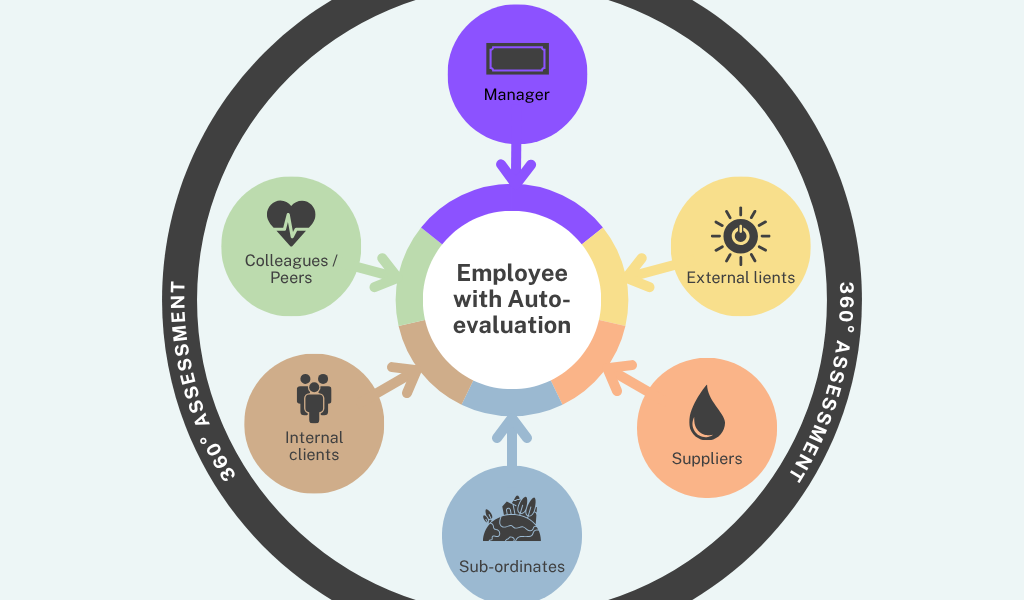
“Do my counterparts really have to evaluate me?” he exclaimed, his voice trembling with indignation. “Yes, this is your 360-degree assessment,” replied the Director of Human Capital.
This man, a manager in a prominent local company, had just received a head-on collision with reality. Throughout the year, he had acted as a free electron, in constant disagreement with his peers, seeking only the exclusive favor of his hierarchical superior. For him, the only opinion that mattered was that of the person who signed off on his bonuses.
His surprise was total, and his anxiety immediate, when he learned that three of his counterparts, the very ones he had despised, were going to actively participate in his annual evaluation. Suddenly, he wondered why he had been so cantankerous, so uncollaborative. His promotion, his bonus, and his reputation now depended on those he considered obstacles. This is the full power of this assessment: it shatters the distorting mirror of the ego. Imagine that your collaborators, your peers, and sometimes even your clients or suppliers, give their opinion on you, not on your technical skills, but on your attitude, your empathy, and your leadership style. The repercussions can be seismic, both relationally and financially.
Moving from a classic pyramidal evaluation to a circular system radically changes the power dynamics within an organization. To understand why this tool has become indispensable for the fulfilled leader, we must dive into its theoretical foundations and deep philosophy.
1. Principles and approach of the 360-Degree Assessment
Leadership does not take place in a tunnel, but in an ecosystem. A leader must learn to consider all members of their system, not just their superior. The 360-degree assessment is based on a principle of radical transparency and shared responsibility. It starts from the premise that the truth about a leader’s impact is not found in a single gaze. Rather, it resides in the sum of perceptions of those who surround them daily. It is an exercise in humility that transforms criticism into fuel for growth.
a. The foundations: Where does this circular vision come from?

The origin of the 360-degree assessment dates back to organizational psychology research, but it was truly propelled by the US military during the World Wars to evaluate officers from different angles. It then became democratized in the 80s and 90s thanks to pioneering companies like General Electric or ExxonMobil. The basic principle is simple yet revolutionary. It involves collecting anonymous feedback from the individual’s entire professional circle. Unlike the classic annual interview, which is a bilateral conversation between a boss and a subordinate, the 360-degree approach creates a complete panorama. It rests on the idea that collaborators see facets of the leader that the boss will never see. The key principles are anonymity, to guarantee the sincerity of returns, and benevolence, as the tool is not a weapon of destruction but a lever for development.
b. The approach: How to orchestrate a 360-degree assessment?
The approach to this assessment cannot be improvised. It requires a rigorous methodology to prevent the exercise from turning into a settlement of scores. Everything begins with an awareness phase where the objective is explained: continuous improvement. Next comes the choice of “evaluators” (or respondents). The leader chooses, often in agreement with the Director of Human Capital, a representative panel: direct subordinates, colleagues of the same level, and the hierarchy. The approach is multidimensional. Structured questionnaires are used to evaluate behavioral skills (soft skills) such as communication, conflict management, delegation, and strategic vision. What is fascinating in this approach is the confrontation between self-assessment and the perception of others. It is in this gap—sometimes abyssal—that real transformation opportunities are hidden.
We recommend reading this article on the leadership tool:The Deming Wheel or PDCA.
Once the framework is set, it is essential to understand what this evaluation report actually contains and, above all, what tangible benefits the leader and the organization can derive from it.
2. Content and advantages: The mapping of excellence
The final report of a 360-degree assessment is much more than a simple compilation of grades. It is a precise mapping of an individual’s influence. For the leader aspiring to the P.A.I.X method (Preparation, Attitude, Impact, Infinity), this document becomes a roadmap for the years to come. It allows one to step out of denial and identify “blind spots.” These are behaviors we adopt unconsciously that sabotage our effectiveness or that of our teams. By understanding the content and advantages of this tool, the manager begins to sculpt their environment.
a. The content of the 360-Degree Assessment: Deciphering human performance indicators
The content of a 360-degree assessment is generally divided into several categories of skills. First, we find management skills (strategy, decision-making), then interpersonal skills (emotional intelligence, listening ability). The report presents results in the form of comparative graphs: how I grade myself vs. how my team grades me. A section is often reserved for anonymized free comments. This is often where the “substance” of the exercise is found. These are phrases that describe a specific behavior, an irritating habit, or an inspiring quality that had never been formulated. This content is a gold mine because it objectifies elements often judged subjective, thus allowing for the setting of concrete and measurable development goals.
b. The advantages: Why accept this introspective journey?
Accepting a 360-degree assessment is an act of managerial courage that unlocks unsuspected performance levers. Far from being a simple administrative formality, this introspective tool offers radical clarity on your real impact. By aligning your intentions with the perceptions of those around you, you transform your leadership into an engine for collective growth, retention, and organizational agility. This approach offers you a panoramic vision. It combines your own gaze with that of your entourage, perfectly illustrating that the union of perspectives makes the leader’s strength.
Strengthening self-awareness and adjusting the cursor
The primary benefit for the executive is the elimination of blind spots. We all have a residual image of ourselves that does not always correspond to the perceived reality.
Practical example: A CFO perceived himself as “rigorous and protective of procedures.” The 360° feedback revealed that his peers perceived him as “an obstacle to change and lacking empathy.” This gap created unnecessary friction. By adjusting his communication to explain the why of the procedures rather than imposing them, he transformed his perception from a “brake” into a “guarantor of security,” thus improving his relational fluidity by 40%.
Establishing a climate of trust and relational justice

For the team, the 360-degree assessment is a strong signal: that the manager is a human in learning. When collaborators see that their feedback is heard and followed by concrete actions, the feeling of organizational justice explodes. A model to follow: The leader should organize a “humble feedback meeting” after their assessment. Instead of justifying themselves, they thank their collaborators for their frankness.
Practical example: A department head who received feedback on his lack of delegation established an explicit “right to error.” This gesture freed speech and initiative. By showing his vulnerability, he created a space where his collaborators no longer fear failing, which is the fertile soil for innovation.
We encourage you to read this article on the leadership tool:The Eisenhower Matrix to master your priorities.
Optimizing talent retention and reducing hidden costs
Financially, the 360-degree assessment is a high-yield investment. The departure of a key talent often costs between 6 and 18 months of their salary in recruitment fees and lost productivity. The #1 cause of resignations is the relationship with the direct manager. By treating relational frictions before they become ruptures, the leader preserves the company’s human capital.
Practical example: In a logistics plant, the implementation of the 360° identified a manager whose authoritarian style caused a turnover 30% higher than average. Coaching resulting from the assessment stabilized the team. This saved tens of thousands of euros in training newcomers and overtime to compensate for absences.
Creating a culture of excellence through permanent feedback
Finally, this tool installs a culture where feedback is no longer an aggression, but a valued exercise. In an organization that advocates fulfilled leadership, excellence is not a destination but a continuous adjustment process. It is advisable to move from feedback (analysis of past errors) to feedforward (constructive suggestions for the future).
Practical example: Following a 360° assessment, a company generalized monthly “Check-in” sessions based on matrix criteria. Rather than waiting for the stressful annual interview, teams now discuss behaviors to strengthen openly. Common exchanges have become the fuel for daily performance. They have allowed the organization to remain agile in the face of market crises, as each member is focused on improving the collective.
However, theory remains vain without the test of facts. To understand the real impact of this tool, let us examine three trajectories of leaders confronted with their own reflection.
3. Testimonials: Three destinies facing the 360-Degree Assessment mirror
The 360-degree assessment is a catalyst. Depending on the leader’s open-mindedness, it can be the trigger for a meteoric rise or the revealer of an imminent fall. Through these three true stories, the disappointed colleague, the transformed manager, and the leader seeking loyalty, we will see that the tool is only the means. It is the attitude of the heart that determines the final result. These testimonials perfectly illustrate how others’ perception becomes our social reality within the company.
a. The disappointed colleague: The trap of denial and paranoia
Jean-Marc’s story is a warning. After receiving his 360-degree report, Jean-Marc did not seek to improve; he sought the “culprits.” Convinced he was an exemplary manager, he was struck down by feedback from his peers who judged him opportunistic and unreliable. Instead of analyzing the why of this perception, Jean-Marc spent weeks trying to guess who had written which comment. He entered a spiral of paranoia, isolating himself further. The lesson here is brutal: the 360-degree assessment does not mask the perception others have of you. Even if you think you are right, if ten people tell you that you are wrong, it is their reality that governs your relations. By refusing to accept the gaze of others, Jean-Marc wasted a unique chance to restore his professional reputation.
b. The hard manager transformed by the 360-Degree Assessment: From “Little Boss” to inspiring leader
Conversely, the example of Paul, production director, is a victory. Paul was known for his hardness, a “command-and-control” style inherited from another era. His 360-degree assessment was an electroshock. While his superiors praised his results, his collaborators described him as insensitive and driven solely by personal ambition. The feedback was harsh, almost violent. Paul could have become defensive, but he chose humility. He gathered his team, acknowledged his mistakes, and began coaching on empathy. The points for improvement were clear: delegate more, celebrate collective successes, and listen before deciding. In one year, the atmosphere of his department radically changed, proving that feedback, even negative, is the starting point of greatness.
c. The manager seeking alignment: The “Good Father” facing strategy

Finally, consider the case of Sarah. Her assessment revealed an atypical profile. There was excellent feedback from her team, who adored her, and neutral opinions from her peers (the “good father/mother” profile). In contrast, the feedback from her general management proved very worrying. Her superiors felt she did not adhere to the corporate culture and lacked loyalty toward the global vision. Sarah protected her collaborators so much that she forgot the strategic imperatives of the hierarchy. The 360-degree assessment showed her that a good leader must not only look down but must also be a loyal partner to those who lead. She had to learn to realign her leadership style to balance team well-being and senior management requirements.
These stories show us that the 360-degree assessment is a truth test for anyone who wants to lead a fulfilled and consistent professional life.
Conclusion: Dare to face your own reflection to grow better
In summary, the 360-degree assessment is the preferred tool of the modern leader who refuses complacency. It allows you to validate your achievements, flush out your hidden weaknesses, and above all, harmonize your professional relationships. A fulfilled leader is not one who has no flaws, but one who has the courage to look them in the face to transform them into strengths.
Tell us in the comments how this tool has allowed you to improve. If this article was useful to you, share it around you to help other leaders become a better version of themselves.